
Jumpsuits
My first jumpsuit was white, Tyvek, given to me by my then-employer Vestas Wind Systems A/S. This in my capacity as an Assembly Worker in their wind turbine blade factory in Brighton, Colorado. They gave me this jumpsuit because building wind turbine blades is messy, done almost entirely by hand, and the materials used are dangerous—fiberglass, epoxy, hot putty dispensed from a machine. They gave me this jumpsuit because, as the New Hire Training explained, and as reinforced by the Super Fun!™ Corporate Posters in the locker room, cafeteria, and factory floor: Safety First is the Vestas way. Safety First: safety jumpsuit.
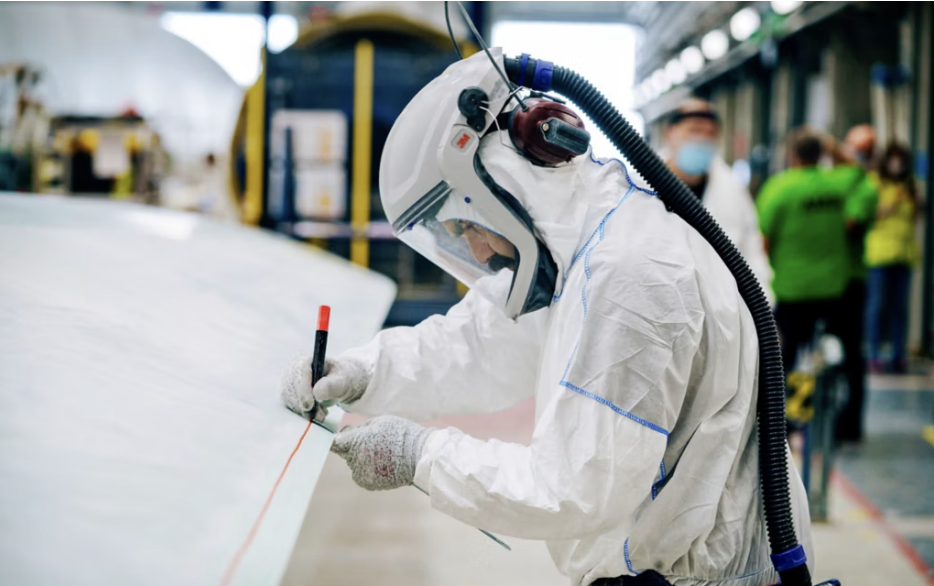
It fit terribly. It limited mobility and created a greenhouse-sweat effect that after a 12-hour shift bordered on apocalyptic. But I was grateful for it. My Division, Finishing, was the messiest in the factory, and generated vast amounts of fiberglass dust, which is bad for your skin, eyes, and airways, and not something you want to take home to your aging parents and small dogs and asthmatic lover. And the fiberglass dust was most of the job. 95% of what I did was this: I took a power sander and polished blades. 12 hours a day, four days a week. Standing and hunched or kneeling, with my right arm and my left, taking care not to get a rotator cuff injury, which I’d been warned about, and that none of the dust got through the gaps in my mask, which I hadn’t. By far the hardest job I have had.
For less than two months I did this, a 21-year-old white American man working a summer job after graduating college. An anomaly. On the factory floor, workers skewed older, immigrant, and non-degree. (From my onboarding: “We’ve had people work here, at some point, I think, who went to college.”) These were adults who needed work. I was a kid, living with my parents, commuting in my dad’s car to a job an hour away that I’d taken for all of the wrong reasons.
My main reason: to be a Rugged Man.
It was a foolish decision. There were easier, better paying jobs close to home. The café up the street had openings. I’d hosted at a Thai restaurant throughout college and they’d promised to rehire me, sight unseen, anytime I wanted. But to my masculinity-obsessed 21-year-old mind, these were the jobs of liberal arts weenies, English majors and theater minors (me) who kissed their friends at parties (me) and cried at the end of Hamilton (very much me). Not so with the factory job. That was the work of a Rugged Man. A tough guy in steel-toed work boots and a Tyvek jumpsuit.
Suffice to say, that is not what my coworkers saw. A pimple-faced kid, energetic but not very good at his job, kind, but woefully out of touch. A soft boy who wore a hat with a rainbow on it from his family trip to Provincetown and sometimes had painted nails beneath his work gloves. A new hire who had effectively quit before his first day, he just hadn’t realized it yet. They kept their distance.
More typical on the factory floor, and hired at the same time as me, was Mahmoud. Extremely kind and patient. Mahmoud, about 40, Moroccan, new to the US, and working to support his wife and young son while the family got settled. Mahmoud who often brought plain white rice for lunch. Who had training as an HVAC repairman, was overqualified for the power-sanding gig, and who confided in me after our first week, “I do not like this kind of work.”
Me neither, Mahmoud.
A key difference here being that I, thanks to an unfair portion of luck, had the option of quitting. I didn’t have a family to support. I didn’t have a life to build as an immigrant in a racist country. I had no one depending on me, nothing to lose, and about every privilege imaginable, with the possible exceptions that I was Jewish, queer, and low-income—but I mean, come on.
Mahmoud was sacrificing his well-being in the pursuit of a better life for himself and the people he loved. I was vainly pursuing a flawed sense of manliness, that after six miserable weeks I’d failed to achieve.
So I quit. Without, I am ashamed to say, telling Mahmoud (or Vestas). I just stopped going. Put all my shit in my dad’s old car and drove off to Be A Writer in New York. Towards a freer hell.
***
Six years after Vestas, I got my second jumpsuit. The jumpsuit I am writing in now. This one is black, denim, and purchased of my own volition from the Target women’s section out of a petty desire for a bold, artsy outfit in which to make bold, artsy decisions. This in my capacity as an art student, early in my writing MFA.
For reasons unknown (perhaps vanity), it suddenly seems very important that I wear the right clothes for what I’m writing. And where historically my fashion-sense has been something like “lumberjack who jogs,” I now want to look like a lumberjack who paints. An androgynous lumberjack, who paints nudes.
And yes, it’s not a big deal. It’s a jumpsuit. A run-of-the-mill outfit.
But no, to me, it’s huge.
For me, a masc man with a masc background and a masc wardrobe, a women’s jumpsuit is a sartorial leap. It shows my butt more than I’m used to, suggests I am perhaps more genderqueer than I usually am, and with its lack of waistband has reignited the middle school anxiety of what to do if you get an erection in public. And where shirts and pants cover, a jumpsuit encapsulates. It’s an outfit in a single article, a complete vibe. And it’s hard to get out of. You can tear off a shirt and pants, but a jumpsuit? For me, it’s a minutes-long chrysalis emergence.
And here things get a little kinky and pretentious: the jumpsuit has become a metaphor for the type of work I am in art school to do. I’m trying to show my butt more, to ask the right questions of gender, to understand how shame travels. To write more, period.
For the first time in my life, I’m being paid to be an artist. And weirdly, gifted with time and money to work on my art, I’m tempted like never before to phone it in. To not write at all. Or when I do, to write towards what I think people will like, not what I want and need to say.
Funny enough, when I write from this fearful place, I end up sounding like someone trying to sound like a Rugged Man—like that pimple-faced kid in a Tyvek jumpsuit. A bad Hemingway impression. Hemingway with a buttplug he’s refusing to acknowledge.
And I don’t like that I do this, but I get why. The voice of a Rugged Man is one of the safest voices one can write in. Entire literary canons have been constructed out of love for Rugged Men. Androgynous Painters of Nudes? Well, some, for sure, but less.
And so basically since I bought the jumpsuit I have not been wearing it. It fits well, I like how it feels, but I’m scared of its implications: the cold sweat of responsibility, the big artistic questions, the “real” work. It forces me to ask: What am I presenting? How am I being perceived? Are that presentation and perception true?
We are all, always, writing the characters of ourselves. And it feels vain, problematic even, to think that the clothes we wear are an important part of our character—the true self is of course, always naked. But I think they are. In conveying one’s self to the world, in accepting one’s own bleeding edges, clothes are, yes, an important tool: a sensory reminder of the ever-becoming self.
So here I am in my jumpsuit. My butt is showing. I’m trying.
