
The Memory of Water: a Review of Gbenga Adesina’s Death Does Not End at the Sea
Gbenga Adesina combines a deep mourning for his father with the communal grief of immigrants, refugees, and the global Black life in his stunning debut collection, Death Does Not End at the Sea (University of Nebraska Press, 2025), published nine years after his chapbook, Painter of Water (African Poetry Book Fund, 2016). This collection continues Adesina's attempt at “a private elegy to a communal pain,” as mentioned in his 2017 interview with Matthew Thorburn on Ploughshares. Adesina describes this practice as “against forgetting,” and though this book contains beautiful love poems, colored in Adesina’s subtle elegiac brushstrokes, the main through line is grief, and memory.
Adesina is a lyrical poet with a keen eye for images. For the speaker of Adesina’s poems, there is a silence in the language of the dead that must ring out in the song of the living. But the poems in this collection not only employ a musicality that transforms profound pain into a lyrical, almost prayer-like experience for the reader, they also borrow potent lyrics from the language of the natural world, particularly the watery realm, ocean, seas, migratory water birds, and horses—“the animals of grief.” This collection carries an awareness of the elusive citizenship of people in a world ravaged by death and destruction, and attempts to build, from memory, a “choral country” of cultural and historical significance, as an act of remembrance.

Gbenga Adesina
Death Does Not End at the Sea is divided into three main sections, but the book, as a whole, opens with a prologue, a praise poem titled “Glory.” This introductory poem sets the mood of elegiac celebration that runs throughout the collection. In “Glory,” the speaker extols the prescence of beauty in ruin and decay, using the natural imagery of a world where the “glory of waterbirds,” existing simultaneously with the “glory of thirst,” moves, ultimately, to the more personal and vulnerable image of his father’s eyes—one “which when he died, closed / inside his grave, // and opened even more brightly / inside me.” The speaker's voice feels intimately tied to the poet's own life experiences, with “Section I” confronting the speaker’s past and childhood, the painful post-colonial history of his country, Nigeria, and the eventual death of his father. In “I Carried My Father Across the Sea,” the first poem of the first section, the speaker asks, “What sort of a son / leaves his father / chained to fatherhood?...What sort of a son / leaves his father's body / chained to the dark grievance inside the earth?” introducing a key narrative throughout this collection—the idea of filial responsibility. This idea is echoed in the speaker's deep connection to his deceased father and the sense of carrying on his work and memory. One specific image mentioned in the poems that follow is the speaker's mission to show his son's eyes the cities his father's never saw. In “In Search of James Baldwin in Paris,” he writes:
My father [...] loved maps
[...] regaled me with
the names of exotic cities: “Do you know Bujumbura? Do you know
Turin and Verona? One day, I’ll take you to Marseille.”
But a heavy, invisible duty held him bound to a small place. He never
traveled. So, I vowed the eyes of my son would see the world.
With this reference to duty, the poem stages a direct transmission of responsibility across generations: the speaker’s commitment to travel becomes a symbolic act of repair, a way of reclaiming the mobility denied to his father by economic, political, and postcolonial constraints. In many African and diasporic traditions, such acts of movement function as forms of ancestral remembrance, transforming travel into an inheritance, a means of fulfilling an interrupted legacy and ensuring that what one generation could only imagine, the next might finally embody.
Interspersed throughout this collection is a series of narrative place poems that share form and structure with “In Search of James Baldwin in Paris.” These poems follow the speaker and his son as they tread James Baldwin’s path in history. The first section of the book ends with one such poem, “Envoy to the South of France.” In this poem, their “search” leads them to a restaurant where the speaker's “son decided to break / dance to a song in his head” in public, making the speaker deeply afraid, until he “heard laughter and claps and clinks of glasses.” There is a disconnect in the experience of the speaker and his son in this poem. The son in this poem is himself, a symbol of the future, but also perhaps a figure for the poet outside the memory of segregation or racism outside of the “past of our ancestors.”
The second section consists solely of the titular poem, a long sequence, “Death Does Not End at the Sea,” which follows, across seven main parts, an ensemble of voices, ghosts, and survivors, travelling across the treacherous waters of the Mediterranean sea. The sequence also references the Atlantic Ocean by weaving in the historical memory of the Middle Passage. It opens with the epigraph, “On the Mediterranean. / The chorus is the muscle memory of the sea,”—an epigram by the author—and continues, “...the prayer is not to the whorl scarf / of waves. The prayer is to the fitful sleep of the dead. / Look. You must look.” The whole sequence is a series of different images and voices commanding the reader to look, to observe and bear witness to the lives and stories of people permanently marked by their voyage, in an exile of circumstance, across the sea: “We are at the edge / or middle of nowhere,” one voice announces, “a geography of melancholy, where / no hand of father or nation reach out / to claim us.”
The images evoke a profound sense of displacement that unmistakably recalls the Middle Passage—the forced transatlantic crossing that carried millions of enslaved Africans into the Americas. That historical memory lingers beneath the poem’s surface, shaping its atmosphere of rupture and unmoored identity. The voices that speak throughout the sequence are filled with longing; they belong to people severed from a previous life, suspended between homelands, and searching for a place where they might belong. In this liminal state, their only remaining tether is song, and this is a motif that resonates with diasporic traditions in which music becomes both a survival strategy and a repository of cultural memory. The poem’s speakers reach for “a deeper tongue,” gesturing toward the loss of linguistic, cultural, and ancestral continuity experienced by displaced peoples—from enslaved Africans stripped of their languages to contemporary migrants navigating new and often hostile terrains. Their attempt to speak fractures, “break[s] like a ladder that does not lead to heaven and does not lead to earth,” capturing the impossibility of return and the uncertainty of arrival. This broken ladder becomes an emblem of diasporic dislocation: neither a path back to origins nor a bridge toward a secure future.
What follows is the devastating chorus that concludes fourth poem of the sequence’s first part, a refrain that gathers the poem’s spiritual, historical, and emotional weight into a single, haunting invocation:
The children of God are upon frightened waters
and God being hunger, God being the secret grief of salt,
moves among his people and does not spare them.
The children of God are upon frightened waters.
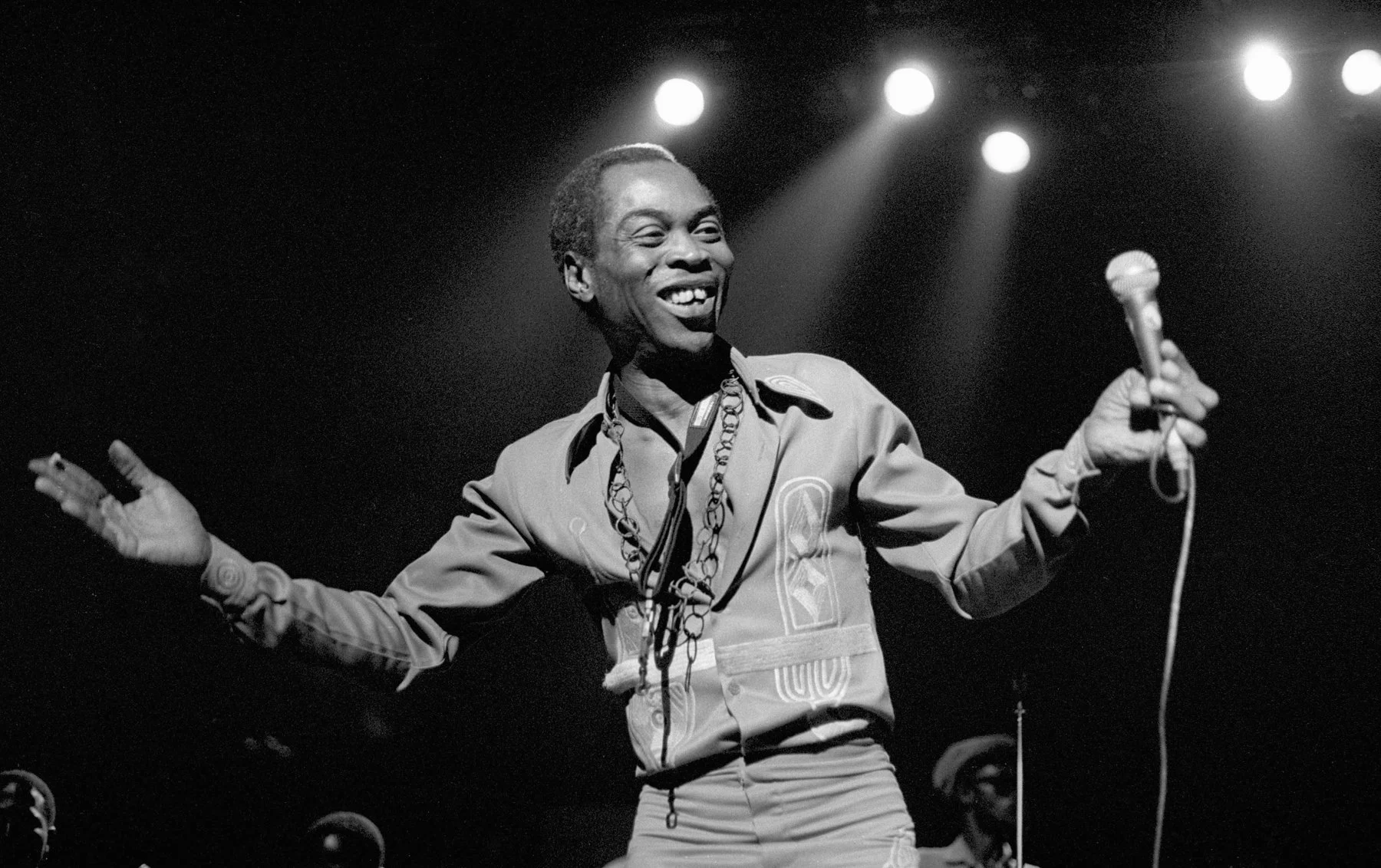
Fela Kuti
“These are the waters of my intimacy,” one of the voices says in the section that follows, “the waters of my estrangement.” Later, another declares: “The Sea is the grave and the grave digger.” These lines evoke the long and complicated relationship between Black people and water, one shaped by both terror and necessity, and by rupture and renewal. Across the Black Atlantic, water is never a neutral element. It remains in memory as the site of the Middle Passage, the mass grave of millions, and yet also the medium through which diasporic cultures, religions, and languages traveled and transformed. Scholars such as Paul Gilroy have described the Atlantic as a “counterculture of modernity,” a space where trauma and creativity coexist. In this sequence, Adesina continues that lineage: the sea becomes both an archive of loss and a living force that shapes identity. This duality is also reminiscent of the song,Water No Get Enemy by the Nigerian Afrobeat legend, Fela Kuti, who is referenced in many of the poems in this book. In Kuti’s song, water is indispensable—life-giving, cleansing, unavoidable—yet it is also capable of destruction. A child, killed by water, is given a ritual bath with the same water, showing how harm and healing can be intertwined, and how the elements that wound also restore. Adesina’s invocation of this cultural memory situates the poem within a broader African and diasporic cosmology in which water is a carrier of spirits, histories, and unresolved grief.
The third section returns the reader to the present, where the speaker confronts ancestry, belonging, and the unstable terrain of citizenship as a Black man in diaspora. The section culminates in his ongoing search—undertaken with his son—for the ghost of Baldwin across various global cities. Even as he admits that “there is no cure for longing,” the speaker must face, as in the opening poem “In Search of James Baldwin in Istanbul,” the immediacy of “this slice of hour / alive and eternal with all my longing and fear.”
The poems that follow deepen this inquiry. “Citizen” begins with the striking declaration, “The only citizenship I have was given to me / by the Brooklyn trees,” suggesting that belonging is found not in nation-states but in lived experience, in the places where one’s body has learned to breathe. In “116th Street,” the speaker seeks a spiritual lineage rather than a legal one, offering “a mute prayer among the godheads (Baldwin and Coltrane)” at the Cathedral of St. John the Divine—an invocation of Black artistic ancestors whose work has shaped diasporic identity as profoundly as any homeland. “Paradise” then returns to Nigeria, where the speaker “arrive[s] at a city called Paradise,” a place whose walls were “burnt in the last century and rebuilt only in a dream,” evoking the cyclical destruction and imagined reconstruction that mark many postcolonial landscapes.
“In Search of James Baldwin in Senegal” brings these threads together. Observing the hawks circling above, the speaker wonders whether they “pass along to their offspring…what they saw happen on this island,” invoking Gorée Island and its role in the transatlantic slave trade. Yet when he instinctively shields his son’s eyes from “coffles, chains, and whips,” he questions his own impulse: “What was I trying to protect him from?” The poem refuses an easy answer. Instead, it reveals how desire and fear, love and grief, coexist in the intergenerational transmission of memory. The emotional layering recalls the tonal complexity of Denise Riley’s A Part Song, where mourning and tenderness are inseparable. In Adesina’s hands, this tension becomes a way of acknowledging that the past is never past, but is inherited, embodied, and continually negotiated by those who come after.
What ultimately distinguishes Death Does Not End at the Sea is not only its thematic ambition but the precision and beauty of Adesina’s craft. His poems operate through a lyric intensity that refuses spectacle; instead, they enact a poetics of the aftermath, attending to what remains after catastrophe—memory, breath, the fragile persistence of song. Adesina’s lines often move with the cadence of prayer or incantation, but they are grounded in the sensory world: salt, wind, birds, maps, the weight of a father’s body. This fusion of the spiritual and the material gives the collection its distinctive emotional charge.
One of Adesina’s most striking techniques is his use of choral multiplicity. In the title sequence, the shifting voices—ghosts, migrants, sailors, the drowned—create a polyphonic structure where the poem becomes a communal utterance rather than a solitary lyric. This is especially evident in the repeated command, “Look. You must look,” which functions as both an ethical directive and a formal device, pulling the reader into the poem’s witnessing gaze. The chorus that closes subsection iv (“The children of God are upon frightened waters…”) exemplifies this technique: a refrain that feels ancient, liturgical, and yet painfully contemporary.
Adesina also excels at metaphorical layering, allowing a single image to carry multiple histories at once. Water, for instance, is never just water. In “I Carried My Father Across the Sea,” it is grief, inheritance, and the unspoken distance between father and son. In the title sequence, it becomes the Mediterranean, the Atlantic, the Middle Passage, and the present-day migrant routes—an entire geography of displacement. In “Paradise,” fire and ruin become metaphors for postcolonial reconstruction. In “Citizen,” the Brooklyn trees become unlikely bearers of belonging, offering a citizenship rooted in lived experience rather than nation-state recognition.
In Death Does Not End at the Sea, Adesina has crafted a book that is both elegy and invocation, archive and prophecy. His language is lush yet disciplined, his images devastating yet tender. The collection does what the best poetry does: it enlarges the world, insisting that memory is not a burden but a form of light, and that the living and the dead move together across the waters that shaped them.