
Notes on Katie Kitamura's Audition
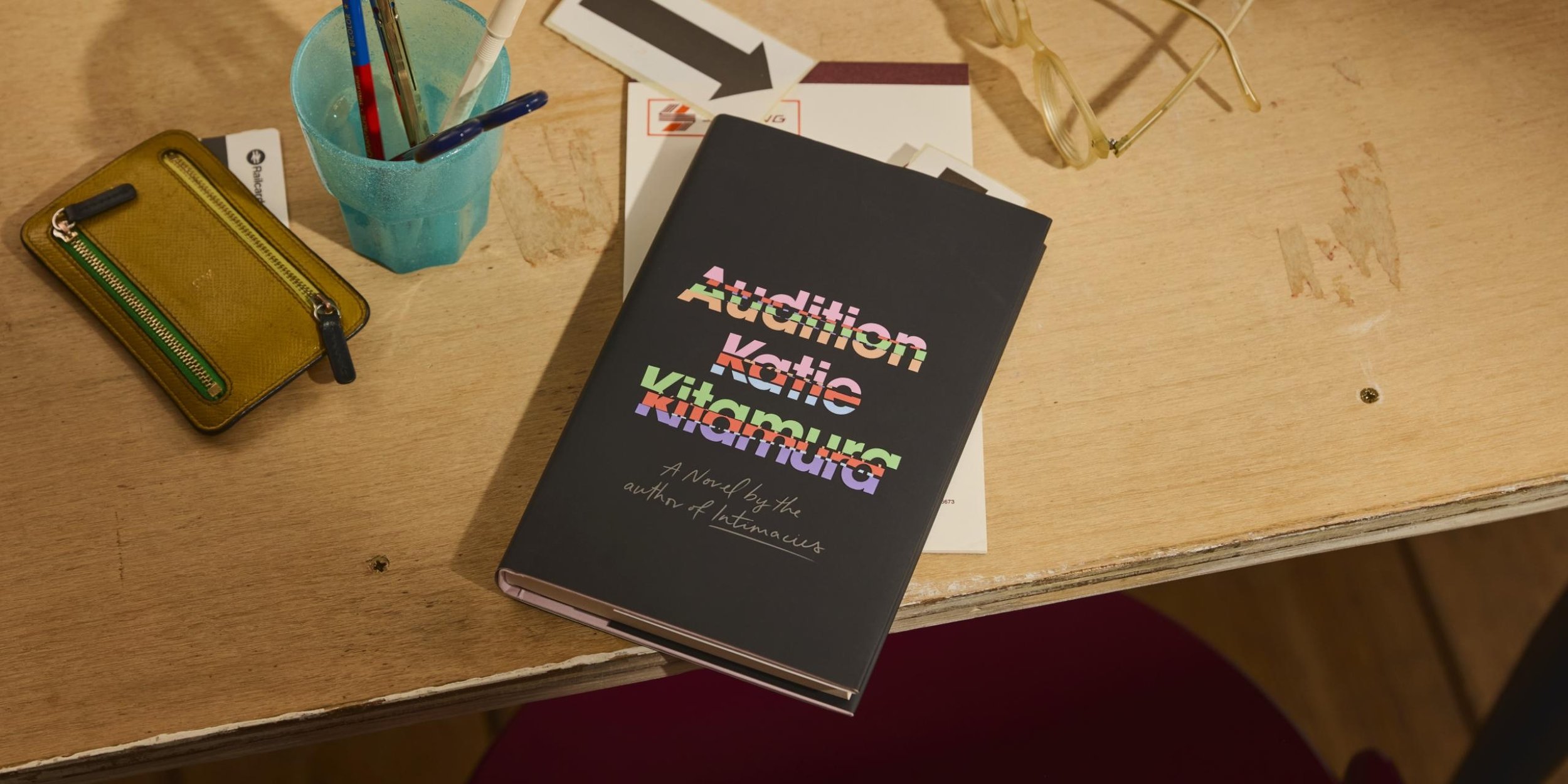
Audition is a maze of hypotheticals: the counterfactual becomes fact, fantasies are already lived out, family is a construction on the brink of collapse. In the author’s own words, “It’s a puzzle, but it’s not meant to be solved.” Kitamura’s latest novel, a finalist for the 2026 Pulitzer Prize and 2025 Booker Prize, cracks open a space for contradictions to play. The idea for the book came out of an article headline which read: “A stranger told me he was my son.” When Kitamura repeated the line to a friend, they responded: “But that’s just a description of parenthood. That’s what it’s like every single time my son comes home.”
Structurally, the book is split into two narratives, or two conflicting realities for the same character. The story is told from the perspective of an unnamed actress who lives with her husband in Manhattan; accomplished, mid-career, she is preparing for her new role in a play. In part one of the novel, the actress is approached by Xavier, a young man who claims she is his biological mother, though she’s never given birth. Halfway through, the novel takes a sharp turn—a split story structure that Kitamura says she’s seen done in films (Mulholland Drive and Vertigo were inspirations), but not so much in literature. In part two, that same actress and same man have a new relationship, incompatible with the first version: Xavier has always been the biological son of the narrator and her husband, Tomas. Audition was designed to be read “in two or three, maybe even four different ways,” Kitamura said. The novel is open to, if not contingent on, the reader’s interpretation.
While part one ends before her opening performance at the theatre, part two picks up right after, so that we don’t see the play itself take place. This blank space at the novel’s hinge mirrors the contents of the play within it: the narrator has a long monologue scene between the play’s first and second half, a crucial turning point for the character she plays. In the novel’s first half, the narrator is deeply troubled by the monologue scene, unable to carry it out in a way that satisfies her. But then something shifts—we don’t know what, neither does she. In the second half of the novel, we learn her first few performances of the show have been a huge success. The narrator describes her experience delivering the monologue as “almost carnal… I was dazzled each time by the scene's infinite contingency, the range of possibility laid out in front of me.”

Kitamura has an inexhaustible ability to observe, then translate those observations into action, tension, negotiation. Through her perceptive narrators, she lends us those sharper instincts until they become our own beyond the page. Each line seems to hit a target, with the kind of accuracy that would be frightening if it weren’t so satisfying. Kitamura possesses that rare level of sensitivity needed to walk us through someone else’s mind. Privately, we watch this narrator translate the gestures and expressions of others into her own language, even when her interpretations fail to match reality. In part one, the narrator thinks through the tense dynamic Xavier (as a stranger looking for his mother) has ushered into her life:
Its source was an imbalance of want. Two people who want the same thing will never generate the same intensity as two people who want different things, or one person who wants into an absence, a void—as was in fact the case with Xavier, who wanted something from me that I could not give. More than that-he wanted something that I could not begin to fathom, a desire with which it felt dangerous to collude or to involve myself. Yes, there had been conflict in the air between us, conflict and intensity, and that had read as carnal interest, because the actual story, the reality of what was happening between us in that moment, was much less easily imagined.
While Kitamura’s first two novels (The Longshot and Gone to the Forest) focus on male protagonists, her last three novels (A Separation, Intimacies, and now Audition) are narrated by unnamed female protagonists. In her own words, she began ‘writing men off: they were either dead, or gone.’ Her female narrators have been interpreters and actors, who speak the words of others, frequently of men. In the first few pages of the novel, the narrator describes this learned instinct that comes with being a woman:
Like all women, I had once been expert at negotiating the balance between the demands of courtesy and the demands of expectation. Expectation, which I knew to be a debt that would at some point have to be paid, in one form or another.
These narrators are more aware of their state of passivity than most of us: they inhabit it, even when it troubles them. To Kitamura, our agency—and the agency of her characters—is mostly an illusion. ‘It is proof of the lulling quality of narrative,’ Kitamura has said, that we think we have a great deal of choices. Her narrators are stuck within that limited range of motion, and they know it. This tension between passivity and agency thrives in Audition, whose narrator grapples with the boundaries of her artform, as well as the range of constraints women must adapt to no matter the role—young women, wives, mothers, professionals.
On a sentence level, Audition is teeming with commas—the lines go on, and on, and on (a dream for comma splice lovers). When asked about syntactic control in her project, Kitamura talked about letting the ‘imperfect sentences’ live. When she began writing in first-person, Kitamura made a rule for herself: “I would never have a character be able to express things perfectly the first time… that’s not how very many of us actually speak or think… it’s the great lie of first-person.” She wanted her characters struggling to articulate their thoughts, finding the right words only after a few tries.
I had tried many times to explain this compulsion to myself—it was a way of being in the world, of relating to the life that was taking place around me, it was a question of being open. But over the years and in particular once I met Tomas, I had learned to curtail that urge, to see it for what it really was—a passing curiosity, a spirit of bedevilment, and a form of voyeurism.
We follow this narrator as she glides from thought to thought, even within a single line. Her mind is endlessly racing, yet the effect is not claustrophobic or anxious, even at the novel’s tensest moments. In her family and workplace, this narrator’s sense of agency is always shifting, as does her version of reality. More action happens inside her head than in the physical realm—it is the space where she can exert full control over the narrative she believes in.
In writing Audition, Kitamura drew inspiration from horror films and novels like Rosemary’s Baby and A Haunting of Hill House. “The real moment of horror,” Kitamura said, “is when you look at something you think you know, and it looks unrecognizable.” There is a moment in Audition when the narrator’s memories of herself suddenly appear constructed and strange. She has to double back and ask, ‘Did I get that right? All this time, is that who I was? Who I am?’ Everything we thought to be true about this narrator and her closest relationships comes into question.
Sometimes that thing you don’t recognize is your life partner, your own child, a piece of yourself, even your full self. There’s this uncanny feeling that the person you woke up as is severed from any version of yourself that preceded it. Every character is supposed to have a backstory, because don’t we all come from somewhere? Kitamura is the only writer I’ve encountered who has pinpointed that feeling, pierced through it, and asked why we have to know. I wouldn’t call the narrator of Audition an ‘unreliable’ one—I never felt betrayed by her misinterpretations or false memories. Maybe because the author herself is who I trust: she is honest about the fact that no one is really honest with themselves, we are almost incapable of it. It is impossible to know oneself in our entirety, let alone the person across from us, no matter how desperately we may try. An existence like that is unsettling. And yet, it is the same existence Kitamura spins into something almost comforting, something real to touch upon.
Early on in the novel, we learn of a morning routine the narrator committed to for the sake of her husband. For every breakfast, they would buy pastries and coffee from the café down the street, and bring them upstairs to eat at home, even if they hardly touched them:
He suggested that we do it again, that we do it daily… I agreed, even though in that moment I didn't think I wanted to, not in the face of his demand, not in the face of my own inclination. I assumed it wouldn't actually happen. But it did, first for a week, and then for a month, and then for so long that it became habit and routine, and in that small act of domesticity, I recommitted myself to the marriage. It was banal, indisputably bourgeois, the coffee cups and the stupid pastries-but that was almost the point. To return to that ordinary life, with its coziness and safety, all those things that are so easy to despise and dismiss. In those rituals of daily life, I committed myself to the marriage, in all its mundanity, all over again. At least for a time.
At Kitamura’s event with Politics and Prose, she and Kat Chow talk about how a disturbing amount of pastries accumulate throughout the novel. For a story set in essentially three locations (the home, the theatre, and the route between them), objects like the pastries, or a scarf, carry significant narrative weight. The pastries are a device, almost one of horror, taunting the narrator, reminding us of her initial reluctance to partake in this ritual. When reading, the absurdity of the routine was not lost on me, but I found her recommitment of marriage more touching than stifling. Perhaps this naive or overly romantic read is because I’m someone who looks at marriages from the other side of a looking glass, unfamiliar with the kind of oppressive intimacies that can occur within one. When at a later point in the novel, Tomas’ character abruptly comes into question, my more affectionate read of him shattered. The knife twisted all the more because of the person I had made Tomas out to be in my head. It is both Kitamura’s precision with her characters, and her restraint as an author, that makes this possible.
At the novel’s end, the narrator describes the process of stepping into one’s role:
Here, it is possible to be two things at once… the natural superimposition of one mind on top of another mind. In the space between them, a performance becomes possible.
The narrator is talking about acting, just as the author is writing about her own craft. But it applies to reading too, when you approach a book as a malleable thing, rather than a work set in stone. Here is the contradiction: that a book we hold in our hands is a finished product, containing a specific reality which the author has set in place, whose unique logic we buy into. And yet the experience of reading any book is wholly individual. Each time we read something, we read it in a way no one else can, not even a younger or older version of ourselves.
At an event in San Francisco for Audition, Kitamura mentioned how boring it is to read a book where the writer is too confident, how the real stakes of a novel are what the writer risks. In crafting the shape of Audition, she went into the drafting process not knowing if the structure would work, if she could pull it off. You can feel such risk to Audition, a leap of faith that both reader and writer must take together. One could offer their many ‘theories’ for the novel’s ‘plot twist’: the first half is a fantasy and the second is reality, the reverse, a delusion, or perhaps both realities exist in separate universes. But as Kitamura suggested, try not to concern yourself with any of those answers when reading Audition. A paradox is not meant to be proven right or wrong, but rather believed for what it is, until it upends our already unstable assumptions about reality.
A great novel shows the reader how it should be read, teaching us its particular rules and exceptions. Yet one of the chief pleasures of reading is that the interpretation is entirely yours to make. Here, the author has given us full permission to let our own desires shape the narrative. The same way an acting audition is about landing a role, this novel, too, casts us in a new part to play. It’s an invitation from the writer, who has asked us: “make this book alongside me.” In the final pages of the novel, the narrator observes the way in which her husband has changed for their son:
He was transformed by the breadth of his emotion, stepping outside himself and extending the boundaries of his being, and I knew that this was one definition of love.
Kitamura has done something similar with this project, exercising a kind of love that extends the work and all its possibilities into our hands. It’s ambitious, and to many readers, unsettling. More than anything, I think it’s the most generous way one can make their art.